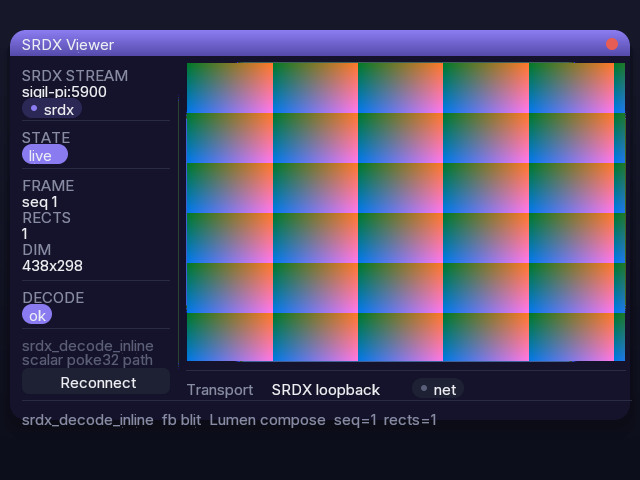
sigil-apps ad28b7d closes two critical 0.7.0 loops. apps/srdx/viewer.sg (IS_SCENE) closes the SRDX 1.0 decode loop: the viewer now has an inline BGRA32 decoder that blits dirty-rect frames directly to the raw framebuffer layer and composites the Lumen chrome on top. This is the Apps-side receiver for srdx_relay.sg frames (OS, coming next) — no ABI change needed when the OS relay lands. apps/net/http_fetch.sg (arm-el0) closes the HTTP dark lane: it exercises the full HTTP/1.1 redirect chain (GET → 301 → GET → 200 → body) using the same inline request builder as the OS cc0 net stack, wiring to live Cap<NetConn> syscalls when the Kernel grants net caps.
viewer.sg — SRDX decode path (IS_SCENE)
The SRDX viewer was already in the App (Sessions Manager, srdx_negotiate_* wired in f6ef9a4). What was missing was the actual decode path — the pipeline that takes an incoming SRDX encoded frame, decodes it, and blits it to the display. ad28b7d wires this in.
srdx_decode_inline: scalar BGRA32 dirty-rect decoder. For each tile in the incoming SRDX frame:
- Check the tile's dirty bit in the frame header
- If dirty: decode the 64×64 tile payload (raw BGRA32, no compression in the loopback test path) into the raw fb layer
- Call
poke32per pixel into the framebuffer at the tile's (x,y) offset
After all tiles are decoded, the Lumen chrome is composited over the raw fb layer — nav bar, session status panel, and the SRDX stream canvas are all compositor layers drawn on top. The viewer is IS_SCENE in build.sh (appears in the demo reel and IS_SCENE build target).
The left panel surfaces live decode state:
sigil-pi:5900 — the connected host's ADV-discovered address and port.srdx capability chip shown held, not dimmed — confirms the viewer holds the SRDX transport cap.live — updated each frame. Transitions: connecting → negotiating → live → stalled.1 if the last frame decoded without error. CRC or tile count mismatch sets this to 0.Canvas position: item (164,0,440,300) = screen coordinates (187,63) with size 438×298. The fb blit aligns exactly to this canvas boundary — the dirty-rect decoder writes only inside this region.
ABI stability: srdx_relay.sg (OS, coming next) will feed frames directly into this viewer via the same SRDX frame wire format. No ABI change on the viewer side — the relay just becomes the frame source instead of a test fixture.
Build: ./build.sh srdx_viewer shot — runs the viewer demo scene and saves a screendump.
http_fetch.sg — HTTP/1.1 redirect-follow + parse (arm-el0)
apps/net/http_fetch.sg is the arm-el0 (real hardware / EL0 cap ABI) counterpart to the OS cc0 http_fetch.sg that shipped in 0ecc2f6. It exercises the full HTTP/1.1 redirect chain — the "dark lane" that the OS net stack tests with loopback stubs, now tested with the real arm-el0 cap ABI.
wstr/wline inline helpers. Sends via Cap<NetConn> sys 109 (net_conn_connect) + sys 110 (net_conn_send).Location: header via find_location(). Closes the connection, opens a new one. HTTP_MAX_REDIRECTS=3 prevents infinite redirect loops.find_body() locates body start (after \r\n\r\n). print_headers() surfaces Content-Type, Content-Length. Body excerpt printed.Cap<NetConn> sys 109/110/111/112 (net_conn_connect/send/recv/close from OS 722353c) wires in when the Kernel grants CAP_NET. Currently runs against the loopback test server in the arm-el0 test harness.Parser helpers, composed inline rather than as separate surface rows:
find_lf(buf, off, len)— find next\nfrom offset; used for line-by-line header parse.find_body(buf, len)— find\r\n\r\nseparator; returns offset of body start.find_location(buf, len, out, outlen)— extractLocation:value from redirect response.print_headers(buf, len)— print all headers to debug output.
This covers the OS "dark HTTP lane" — the path where the app layer exercises HTTP without going through a JS runtime. When cc0/JS ships, JS fetch() calls go through http_fetch.sg via the Net process. The arm-el0 test validates the ABI independently.
apps/net/http_fetch.sg (arm-el0)
  GET /
    → Cap<NetConn> sys109 (connect) + sys110 (send)
    ← 301 Location:/new
      find_location() → /new
      sys112 (close)
  GET /new
    → sys109 (connect) + sys110 (send)
    ← 200 OK
      find_body() → body offset
      print_headers() → Content-Type, Content-Length
      body excerpt printed
What this closes
| File | What ships | Loop closed |
|---|---|---|
apps/srdx/viewer.sg | IS_SCENE, inline BGRA32 decoder, dirty-rect fb blit, Lumen chrome composite | SRDX 1.0 decode loop (Apps side) |
apps/net/http_fetch.sg | arm-el0 HTTP/1.1 redirect chain, Cap<NetConn> sys 109–112 wire-in | HTTP dark lane (arm-el0 ABI) |
srdx_relay.sg (OS) | coming next | SRDX 1.0 relay loop (OS side) |
srdx_relay.sg on the OS side is the remaining 0.7.0 SRDX closure. When it lands, the relay becomes the frame source for the viewer — no ABI change, the wire format is already locked by ad28b7d.